Cory:
Unlock Your AI Assistant Now!
The optimisation of antiplatelet therapy after acute coronary syndromes (ACS) has evolved substantially in recent years, driven by the dual need to reduce thrombotic risk while minimising bleeding12. Although 12 months of dual antiplatelet therapy (DAPT) remains the conventional strategy used in most patients, accumulating evidence indicates that aspirin can be discontinued earlier when effective P2Y12 inhibition is maintained – an approach for which the strongest evidence derives from trials of ticagrelor monotherapy after 1-3 months of DAPT3. European guidelines have adopted this evidence with a conservative interpretation, issuing a Class IIa, Level of Evidence (LoE) A recommendation for P2Y12 inhibitor monotherapy after 3-6 months of DAPT in selected ACS patients not at high ischaemic risk, without specifying a preferred agent, despite notable differences in the supporting data for each P2Y12 inhibitor1. In contrast, the American guidelines have taken a more evidence-aligned position, assigning a Class I, LoE A recommendation to abbreviated DAPT (1-3 months) followed by ticagrelor monotherapy after percutaneous coronary intervention (PCI)2. Although this recommendation more accurately reflects contemporary evidence, the optimal timing for aspirin discontinuation – at 1 month or 3 months – remains uncertain, as no prior study has directly compared these two regimens.
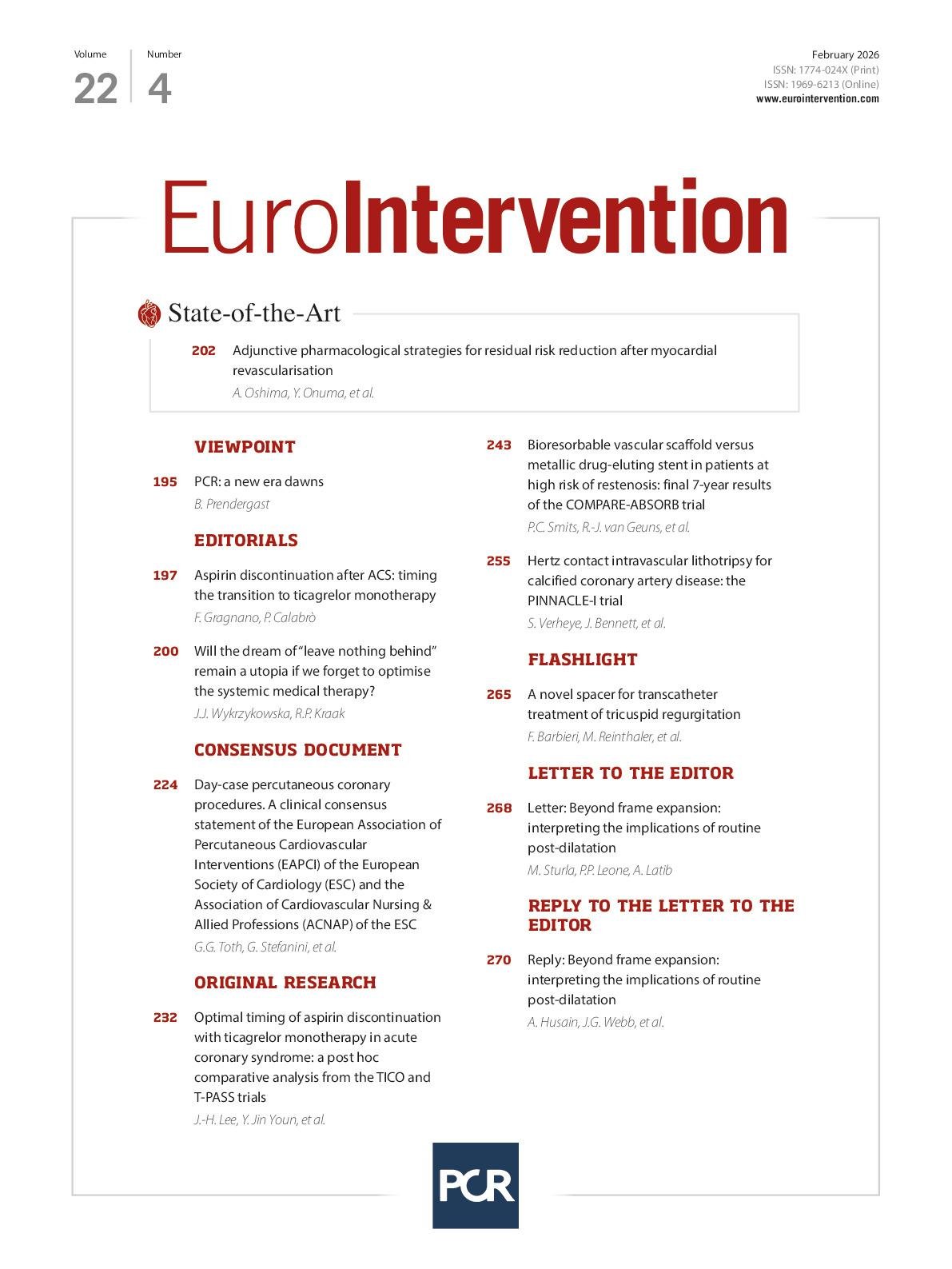
In this issue of EuroIntervention, Lee and colleagues address this clinically relevant gap by pooling individual patient-level data (IPD) from two randomised trials, TICO and T-PASS4, both enrolling ACS patients undergoing PCI with a new-generation sirolimus-eluting stent. The authors compare aspirin discontinuation within 1 month (after a median of 16 days) with discontinuation at 3 months, with all patients subsequently maintained on ticagrelor monotherapy. By harmonising data across trials and applying propensity score matching, the study offers a timely evaluation of these two strategies4.
Overall, 2,953 ACS patients discontinued aspirin and transitioned to ticagrelor monotherapy – 1,426 within 1 month and 1,527 at 3 months. After propensity matching, 2,248 patients were included in the primary analysis. At 1-year follow-up, the primary composite endpoint of death, myocardial infarction, stent thrombosis, stroke, ischaemia-driven target vessel revascularisation, and major bleeding (Bleeding Academic Research Consortium [BARC] type 3-5) occurred in 3.2% of patients in the <1-month group and in 5.6% of those in the 3-month group (hazard ratio [HR] 0.56, 95% confidence interval [CI]: 0.37-0.84; p=0.005). Rates of ischaemic events were nearly identical (2.2% vs 2.3%; p=0.86). Major bleeding was markedly lower with aspirin discontinuation within 1 month compared to 3 months (1.1% vs 3.3%; HR 0.32, 95% CI: 0.17-0.61; p<0.001). Event curves primarily diverged within the first 90 days, when treatment strategies differed4. These findings, derived from a methodologically robust analysis, are clinically relevant and suggest that when ticagrelor monotherapy is used, extending aspirin beyond the first month offers no additional ischaemic protection while increasing bleeding. The novelty lies in the direct comparison of the two discontinuation timepoints within a unified analytical framework. The results should be interpreted with due consideration of prior evidence and potential limitations.
Although the bleeding advantage associated with shorter DAPT is biologically plausible, the magnitude of the reduction – unexpectedly large for a 2-month difference in aspirin exposure – warrants careful interpretation4. In a subgroup analysis of an IPD meta-analysis, ticagrelor monotherapy initiated either within 1 month or at 3 months after ACS provided comparable absolute and relative reductions in major bleeding versus standard DAPT3.
The similar efficacy of ticagrelor monotherapy after 1 or 3 months aligns with prior studies showing that both strategies preserve ischaemic protection relative to standard DAPT3. A contrasting perspective emerges from the recent HOST-BR trial5, which found that among high bleeding risk (HBR) patients undergoing PCI, 1-month DAPT failed to meet non-inferiority to 3-month DAPT for net adverse clinical events at 1 year. This result was primarily driven by a higher incidence of major adverse cardiac or cerebral events in the 1-month DAPT group, without a clear reduction in BARC type 2-5 bleeding5. These findings diverge from other trials in the HBR setting6 and from the present pooled analysis4. Such heterogeneity likely reflects differences in risk profiles, ACS representation, procedural complexity, and the choice of monotherapy after DAPT456. When DAPT is stopped at 1 month, transitioning to aspirin or clopidogrel monotherapy – as occurred in nearly 95% of patients in the HBR cohort of HOST-BR – may lower bleeding but at the cost of increased ischaemic risk, illustrating a trade-off between efficacy and safety57. In contrast, ticagrelor monotherapy from 1 month may preserve ischaemic protection comparable to continued DAPT while reducing bleeding, thereby overcoming this trade-off37. Importantly, a short course of DAPT remains mandatory after ACS, even when potent P2Y12 inhibitors are used. In the NEO-MINDSET trial8, omitting aspirin immediately after PCI and transitioning to ticagrelor or prasugrel monotherapy (in 28% and 69.6% of patients, respectively) increased the risk of early ischaemic events, including stent thrombosis.
Generalisation of this post hoc analysis requires caution4. Both trials were conducted in East Asian populations. The use of a single stent platform may limit extrapolation to other devices. Despite analytical adjustment, patients undergoing <1-month or 3-month aspirin discontinuation originated entirely from two distinct trials with different enrolment criteria, raising the possibility of unmeasured confounders4.
Looking ahead, whether ticagrelor represents the optimal agent for monotherapy remains uncertain, as studies comparing ticagrelor-based strategies cannot address this question3. A pooled analysis of two randomised trials suggests that prasugrel may offer superior ischaemic protection to ticagrelor within the context of DAPT9. Whether this difference in efficacy also applies to monotherapy requires dedicated studies. A further consideration relates to long-term therapy. Ticagrelor monotherapy is evidence-based within the first year after ACS, but continuation beyond 12 months is less well defined3. In the chronic phase, evidence supports the preferential use of clopidogrel over aspirin as maintenance therapy, given its superior ischaemic protection with comparable bleeding10. This delineates a therapeutic continuum in which early aspirin discontinuation is followed by lifelong P2Y12 inhibitor monotherapy, with ticagrelor bridging the vulnerable first year after ACS and subsequent de-escalation to clopidogrel for long-term prevention310.
In conclusion, this study reinforces the evidence supporting early ticagrelor monotherapy after ACS, a strategy to be considered for most patients as an increasingly consolidated body of data challenges the conventional 12-month DAPT paradigm. It is reassuring that comparative analyses of randomised trials indicate that transition can safely occur as early as a few weeks after ACS. Nonetheless, in clinical practice, the optimal timing for aspirin withdrawal within the 1- to 3-month window should remain patient-centred and guided by the anticipated benefit-risk balance.
Conflict of interest statement
The authors have no conflicts of interest to declare relevant to the contents of this paper.