Cory:
Unlock Your AI Assistant Now!
“Evidence-based medicine is not restricted to randomised trials and meta-analyses. (...) Evidence-based medicine means integrating the best available external clinical evidence with individual clinical expertise.”1
Atherosclerotic disease leading to stenosis or occlusion of the arteries supplying the lower limbs (peripheral artery disease) is the third cause of cardiovascular morbidity after coronary artery disease and stroke. Chronic limb-threatening ischaemia (CLTI), with a high amputation rate and annual mortality of ~10%, is the most severe presentation of peripheral artery disease2. Effective pharmacological management is lacking; thus, revascularisation is the fundamental treatment modality – but the best methods remain debated34567 (Table 1). The goals of revascularisation include resting pain relief, limb salvage, and prevention of systemic complications.
BEST-CLI found that – for patients with optimal material for vein bypass (defined as single-segment great saphenous vein) – surgery led to a lower combined rate of major adverse limb events (MALE; above-ankle amputation or major reintervention) and death than endovascular therapy (endo) (42.6% vs 57.4%; p<0.001). However, in those without an optimal vein available (up to 50% of CLTI patients), endo and surgery (using a different bypass) yielded similar results (47.7% vs 42.8%; p=0.12). Drug-coated devices (DCDs; drug-coated balloons [DCBs] and drug-eluting stents [DES]) were superior to plain balloon angioplasty (PBA) and bare metal stents (BMS; hazard ratio [HR] 3.61, 95% confidence interval [CI]: 1.66-7.87)3.
In contrast, BASIL-2 findings supported an “endo-first” approach: major amputation or death was significantly more likely with a surgical vein bypass4. The apparently conflicting BASIL-2 and BEST-CLI results may be partly explained by differences between these trials. The main outcome of BEST-CLI was a composite of MALE and death from any cause, whereas BASIL-2 focused on amputation and death (Table 1). BASIL-2 – but not BEST-CLI – required below-the-knee (BTK) disease4. Nevertheless, nearly 70% of the BEST-CLI population had significant BTK atherosclerotic disease. In BASIL-2, the advantage of endo was driven by a greater likelihood of death with surgery (HR 1.37, 95% CI: 1.00-1.87; mainly cardiac deaths), pointing to the importance of non-revascularised (likely non-diagnosed) coronary artery disease as the signal was absent in patients with prior percutaneous coronary intervention or coronary artery bypass grafting4.
BASIL-3 compared DCD technologies with PBA±BMS, applying a rather unrealistic target of a 40% reduction in amputation5. The amputation-free survival rate of 34% with PBA±BMS was numerically improved with DCB±BMS (40%) and DES (42%), but the confidence intervals narrowly missed the predefined target5. The survival rate also numerically favoured DCDs (40% in the PBA±BMS group, 44% in the DCB±BMS group, and 50% in the DES group). This suggested that DCDs might offer clinical benefits that BASIL-3 was not powered to detect (Table 1). Two recent studies from Sweden (SWEDEPAD 1 and SWEDVASC-Diabetes) have added, by their contradictory results, new fire to the confusion on the role of DCDs in CLTI management67 (Table 1).
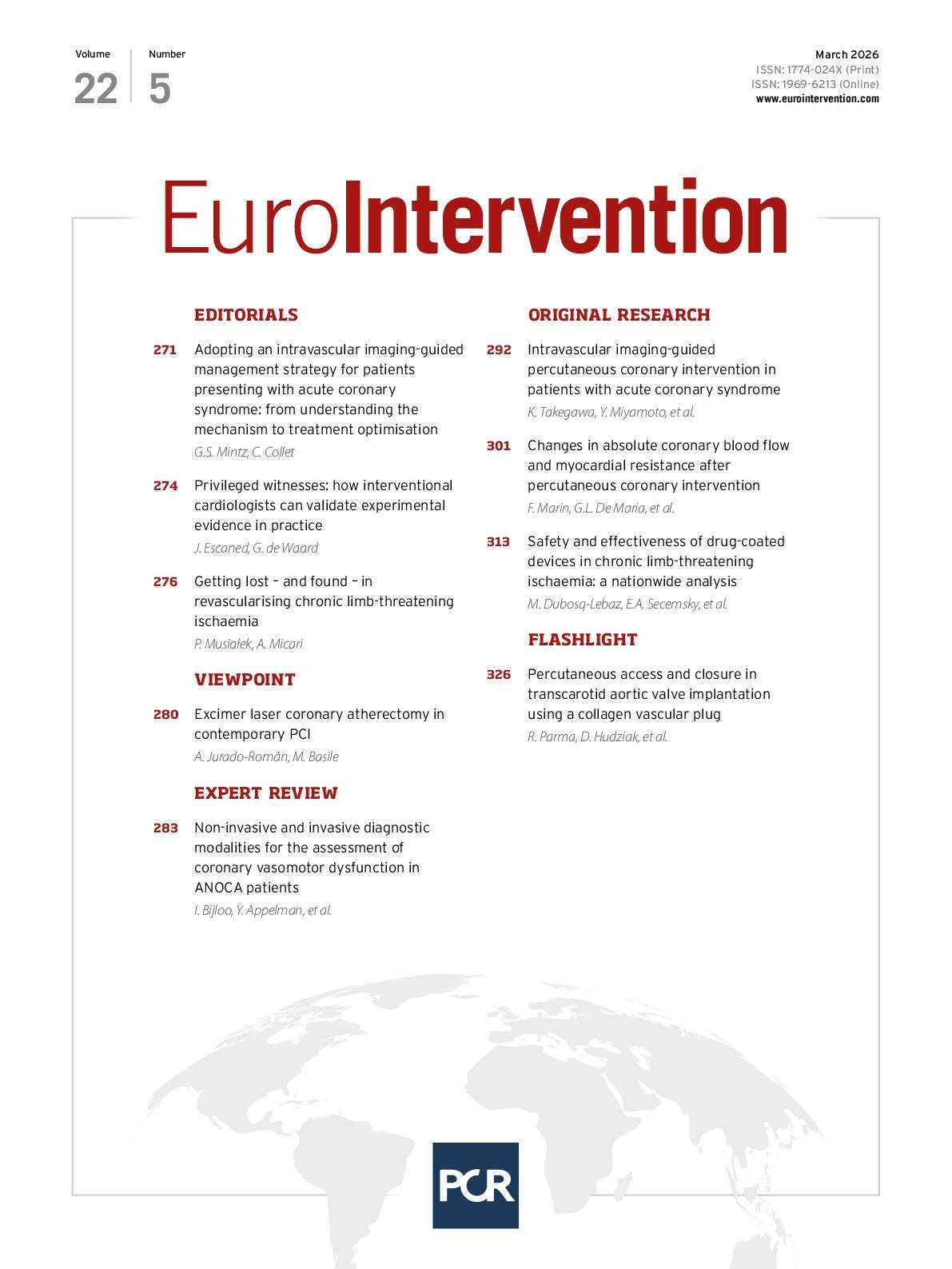
In this issue of EuroIntervention, Dubosq-Lebaz and a multinational team of colleagues share results from their study of endovascular management outcomes in the US Medicare CLTI population (USM-CLTIE)8. The study is a retrospective per-treatment analysis covering procedures performed over 7 years (2016-2023). Clinical and economic outcomes were compared in patients (limbs) managed with PBA±BMS, DCB±BMS and DES in a large-scale (108,304 patients) real-world CLTI cohort. This design deliberately mimicked the BASIL-3 treatment groups58 (Table 1). Outcomes included a composite of all-cause mortality or major amputation, as well as MALE and reintervention. 52.5% patients received PBA±BMS, 30.7% DCB±BMS, and 16.8% DES8. The proportion of BMS use was small (10% after PBA and 3% after DCB). At 5 years, the composite of all-cause mortality or major amputation significantly favoured DCDs, and individual outcomes were in agreement8. DEB use was cost-saving in the long term, whereas DES appeared ~20% more costly. A consistent DCB benefit without increased costs was concluded.
One apparent limitation of USM-CLTIE is the Medicare study population age ≥66 years8; however, there are no mechanistic reasons the results would not be applicable to younger patients. Also, we do not learn how (and to what extent) the use of DCBs mitigates the specific risk factors of a bad clinical outcome as identified in Figure 4 of the article8. Another limitation, not unexpected in a study of this size, is the lack of lesion-level data in the study arms: lesion severity (including the proportion of total occlusions), lesion length, thrombotic content, lesion calcification, and calcification severity are missing. Also, data on the proportion of patients with significant BTK disease (known to affect revascularisation outcomes in CLTI) are not provided8.
The granular data, understandably not available in the Medicare databases, constitute important determinants of the outcomes in the 3 treatment arms subjected to comparison. Regrettably, the roles of lesion-modifying techniques, use of recanalisation and atherectomy devices, and calcium modification techniques could not be evaluated8. Still, USM-CLTIE is a large-scale, powered analysis of real-life outcomes with the 3 current treatments as available today1, including procedures converted to DCB or stenting with DES in lesions initially intended for a PBA-only strategy. It is thus likely that the DCD arms of USM-CLTIE include a greater proportion of complex lesions, with a complexity from PBA±BMS, through DCB±BMS, to the DES cohort that includes conversions from PBA and DCB to a need for a scaffold (stent). Data on the conversion rate from intended balloon strategy to stenting are not provided in USM-CLTIE, but other registries report the provisional stenting rate at ~40%9. Despite these limitations, USM-CLTIE clearly demonstrated the clinical benefit of DCDs and suggested cost-effectiveness of DCBs. USM-CLTIE provides a large-scale, powered, statistically significant validation of the numerical signal from BASIL-35 (Table 1).
From an operator's perspective1, the results from USM-CLTIE suggest that when the angiographic result of DCB angioplasty is satisfactory, DES implantation may be unlikely to improve the clinical outcome8. With the present large-scale evidence from USM-CLTIE, there is no doubt that DCDs exert clinical benefit in CLTI, similar to that established in the coronary field. The numbers needed to treat (NNT) indicated by USM-CLTIE are relevant clinically, with NNT=13 for the reduction in death or major amputation at 2 years for DCB±BMS versus PBA±BMS and NNT=15 for DES versus PBA±BMS8. With accumulating evidence for the benefit of DCDs over non drug-coated devices2, one would expect an increase in DCD adoption during USM-CLTIE. Somewhat surprisingly, the study showed a steady-over-time use of DCB and DES (at the levels ~30% and ~20%, respectively, while PBA±BMS was ~50%)9; the proportions now likely to change with the information from USM-CLTIE [8.
Despite the progress brought by DCD28, CLTI outcomes remain miserable11 (Table 1), and a mountain of work is still needed to improve these outcomes in a major way. Intravascular ultrasound (IVUS) has clear benefits in assessing lesion characteristics, appropriate vessel sizing (and thus balloon diameter choice and stent optimisation) and detection (and thus management) of procedural complications11. Large-scale randomised evidence shows markedly improved clinical outcomes with IVUS use, including ~50% reduction in MALE and ~15% in major amputations12. To some surprise, USM-CLTIE reports IVUS use only in ~4% procedures with PBA±BMS or DCB±BMS and in ~9% procedures with DES8. By optimising endovascular management, a greater use of IVUS would likely improve outcomes in USM-CLTIE; this is an important opportunity to benefit future patients.
While novel technologies (including optimised drug delivery) are emerging13 to improve procedural results of lower-limb revascularisation and its durability, there are no reasons today to deprive CLTI patients from the clear benefit of DCDs8, particularly of (cost-saving) DCBs. Apart from the lack of any plausible mechanism, there is no doubt today, on the basis of data in >250,000 patients, that paclitaxel-eluting devices cause no increase in mortality2. Alleged "new signals" from moderate-size studies such as “increased 5-year mortality with paclitaxel-eluting devices, with no difference at 7 years”6, cannot be considered a factor in the choice of limb- (and, in some patients, life)-saving DCDs28. A DCB should be the number 1 consideration if it is technically feasible upfront. If scaffolding can be avoided on the basis of the DCB result, there is likely no reason to add DES cost to the procedure8.
Last but not least, the patient always needs to be present in the very centre of the decision-making process14. Today, patients have the right to receive full information about the available treatment options and their outcomes14. The patient’s preference, including that for open surgery or endo management, should be respected1415.
Table 1. Key recent studies of femoropopliteal ± below-the-knee revascularisation in patients presenting with chronic limb-threatening ischaemia (Rutherford 4-6).
| Study - year | Design | N and mean follow-up | Intervention(s) | Main findings | Strengths/limitations | Comments |
|---|---|---|---|---|---|---|
| BEST-CLI3 -2022 | Randomised | 1,830 (FP±BTK) ~3 years | Endo vs OS OS=OVB (Cohort-1) OS=OthB (Cohort-2) PBA ~20% DCD ~50% | ↓ MALE/death in OVB-OS vs endo No difference in MALE/death in OthB-OS vs endo Better HRQoL indices in endo vs OS ↓ Major reintervention and death with DCB vs non-DCD | Patients/lesions deemed suitable for both endo and OS | 72% diabetics 67% significant tibial disease OS benefit driven by more reinterventions in endo |
| BASIL-24 -2023 | Randomised | 345 (BTK±FP) ~3.5 years | Endo* vs OS (VB) | Significant ↓ in MA/death in endo 53% vs 63% No difference in MALE No difference in HRQoL | Underpowered (N=600 planned) | Endo more cost-effective Crossover greater in OS than in endo (27% vs 19%) |
| BASIL-35 -2025 | Randomised | 481 (FP±BTK) ~3 years | PBA±BMS (n=160) vs DCB±BMS (n=161) vs DES (n=159) | No statistically significant benefit of DCD in MA/death BUT Numerical DCD superiority: MA/death incidence 66% vs 60% vs 58% | Underpowered (N=861 planned) | ~25% of patients randomised to DCDs did not receive the allocated management Crossover from PBA±BMS to DCB/DES favoured PBA and BMS on ITT analysis Suggestion of cost benefit of DCDs |
| SWEDEPAD 16 -2025 | Registry-based randomisation | 2,355 (FP) ~3 years | DCD vs non-DCD | No difference in MA No difference in mortality ↓ Reintervention with DCD (within first 12 m)# | All-comer recruitment encouraged but "not always feasible" Technical reasons for non-enrolment not captured | Upfront stenting strategy in ~13% Final stenting >30% |
| SWEDVASC-DM7 -2025 | Registry | 1,677 (FP±BTK) ~2 years | DCD vs non-DCD | ↓ MA/death with DCD | All-comer All DM patients Real-life | 100% diabetes |
| US Medicare-CLTI Analysis (USM-CLTIE)8 -2026 | Registry (Medicare) | 108,304 (FP) 5 years | PBA±BMS (10% BMS) vs DCB±BMS (3% BMS) vs DES (100% DES) |
Statistically significant benefit of DCD: MA/death 75.7% vs 71.2% vs 71.7% ↓ MALE with DCD ↓ Reintervention with DCD | All-comer Real-life | NNT for ↓ MA/death with DCD: ~15 at 2 years ~25 at 5 years |
| Limb-related events are per index (study) limb. *Mostly PBA; #not sustained over longer-term follow-up. BTK: below-the-knee (target lesion location); BMS: bare metal stent; DCB: drug-coated balloon; DCD: drug-coated/drug-eluting device; DES: drug-eluting stent; DM: diabetes mellitus; endo: endovascular treatment; FP: femoropopliteal (target lesion location); HRQoL: health-related quality of life; ITT: intention-to-treat; MA: major amputation; MALE: major adverse limb event (above-ankle amputation or major reintervention); NNT: number needed to treat; OS: open surgery; OthB: other bypass (spliced vein, arm vein, cadaveric vein, or prosthetic graft); OVB: optimal venous bypass (i.e., single segment of great saphenous); PBA: plain balloon angioplasty; VB: (any) venous bypass | ||||||
Conflict of interest statement
The authors have no conflicts of interest to declare.