Cory:
Unlock Your AI Assistant Now!
The emergence of angiography-based physiology represents one of the most important advances in contemporary interventional cardiology. Quantitative flow ratio (QFR) was introduced with great promise: a rapid, wire-free, and hyperaemia-free method to extend the reach of functional coronary assessment. By lowering the barriers associated with pressure wires and pharmacological agents, QFR was envisioned as a pragmatic solution to the persistent underuse of physiology in daily practice. Early studies demonstrated good diagnostic accuracy and outcomes with QFR, leading to its inclusion in the European Society of Cardiology (ESC) guidelines as a Class I-recommended approach for guiding revascularisation1.
The results of the FAVOR III Europe trial, however, delivered a reality check2. When deployed across 34 centres in routine practice, a QFR-guided strategy resulted in higher revascularisation rates and failed to meet non-inferiority to fractional flow reserve (FFR) for clinical outcomes. This unexpected finding raised a fundamental question: were the limitations inherent to the QFR algorithm itself or to its application at the point of care?
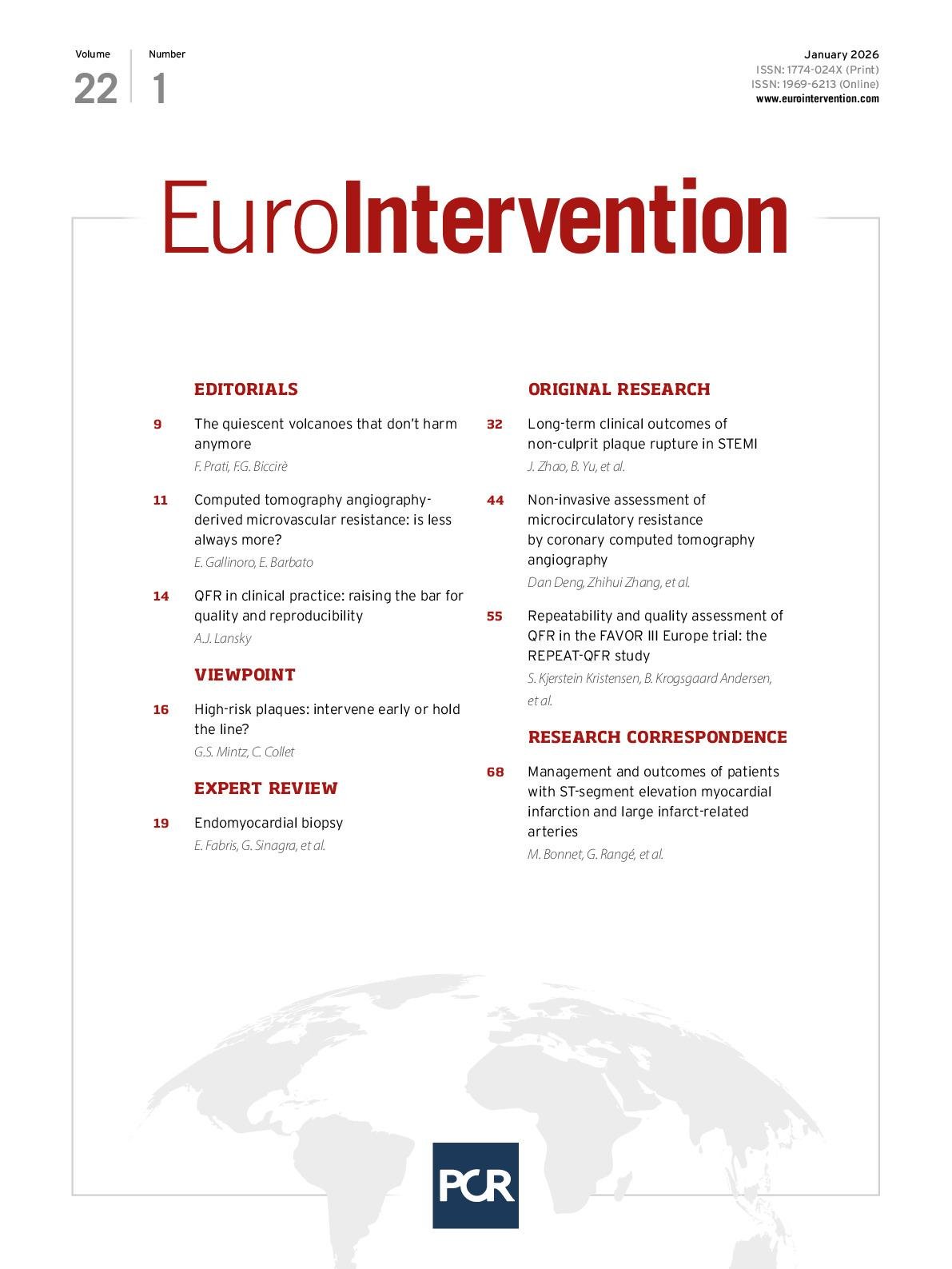
In this issue of EuroIntervention, Kristensen et al discuss the REPEAT-QFR substudy, which provides the first comprehensive data to address this issue3. By comparing more than 1,100 paired in-procedure and core-laboratory analyses, the investigators demonstrated that reproducibility was modest, with only 72% diagnostic agreement and a correlation coefficient of 0.58. Importantly, variability was strongly linked to angiographic quality and adherence to analytical standards. Moreover, poor-quality QFR analyses were associated with a trend towards worse clinical outcomes.
Several insights emerge from these findings. First, QFR performance is highly dependent on angiographic image quality and meticulous adherence to acquisition guidelines. In this trial, nearly one in ten in-procedure analyses were rated as poor or very poor, despite mandatory training and feedback. Second, reproducibility appears vulnerable to the time pressures and variability inherent to real-time procedural decision-making. Compared with core laboratory analyses, in-procedure observers applied fewer contour correction points – reflecting a tension between speed and precision. Finally, lesion complexity and patient factors such as diabetes may further exacerbate measurement variability, likely reflecting underlying microvascular dysfunction or the increased analytical demands of diffuse disease.
What remains unclear is whether the core laboratory assessment represents a closer approximation to wire-based FFR or merely a different manifestation of the same limitations. While core laboratory QFR more closely mirrored the distribution of FFR values in FAVOR III Europe, the absence of direct paired comparisons limits definitive conclusions. Moreover, the reproducibility challenges documented here are unlikely to be unique to QFR; they likely extend to other angiography-derived physiological indices that rely on similar computational principles and image-quality constraints.
For practising clinicians, these results underscore both the potential and the pitfalls of QFR. Angiography-derived physiology may lower barriers to functional assessment, but the modest precision and reproducibility observed here suggest that careful attention to image acquisition and analytical technique is essential if such tools are to safely guide revascularisation decisions.
These findings should serve as a call to action. First, they highlight that angiography-derived physiology cannot be treated as “plug and play”. QFR depends on the integrity of angiographic acquisition and the diligence of analytical technique. Training is necessary – but not sufficient. The field must now demand robust quality-assurance frameworks, including systematic operator certification, continuous feedback, and real-time safeguards embedded within the software itself.
Second, the modest reproducibility observed here highlights the urgent need for technological innovation. Greater automation, integrated error detection, and advanced algorithms are essential if QFR is to achieve the consistency required for widespread clinical adoption. The version evaluated in FAVOR III Europe and in this substudy may not represent the final iteration. Newer platforms with higher degrees of automation are already emerging; their validation should be accelerated – but held to the same rigorous standards of prospective, randomised evaluation.
Third, and perhaps most importantly, the REPEAT-QFR findings must reshape our approach to implementation. A blanket endorsement of angiography-derived physiology, based on limited randomised data, is no longer justifiable. Instead, adoption should be targeted, coupled with structured training, rigorous quality control, and ongoing evidence generation. The time has come to recalibrate expectations: QFR is a powerful tool, but only when applied under the right conditions and with sufficient rigour.
This substudy should not be viewed as a setback but as a turning point. By illuminating the factors that limit reproducibility, the authors provide a roadmap for improvement. Their work challenges clinicians, investigators, and professional societies alike to strengthen the standards by which new technologies are brought into practice.
The REPEAT-QFR substudy makes clear that the promise of QFR remains within reach – but only if we embrace the imperative for quality. Better training, better imaging, and better software are the pathways forward. Advocacy for angiography-derived physiology should now shift from enthusiasm for convenience to insistence on reproducibility and precision. With these commitments, QFR can yet fulfil its potential to democratise physiology and improve outcomes for patients with coronary artery disease.
Conflict of interest statement
A.J. Lansky has no conflicts of interest to declare.