Cory:
Unlock Your AI Assistant Now!
Transcatheter therapies for mitral regurgitation (MR) enable the treatment of patients who are unsuitable or at high risk for surgery. Transcatheter edge-to-edge repair (TEER) is the first-line therapy in patients with secondary ventricular MR, but it is also indicated for patients with primary MR and atrial secondary MR1. However, the use of TEER remains limited by some unfavourable anatomical characteristics (i.e., a very short posterior leaflet, small valve area, complex anatomies). Furthermore, suboptimal TEER results are known to be strongly related with worse clinical outcomes2. Thus, careful anatomical selection and availability of dedicated transcatheter mitral valve replacement (TMVR) systems are crucial in the management of high-risk patients with MR23.
In the last decade, the development of TMVR has been slower than anticipated because of several challenges: delivery catheter sizing, anchoring design, risk of left ventricular outflow tract (LVOT) obstruction, thrombogenicity, and durability.
Today, we are finally turning the corner. Advances in technologies have led to the development of safe and effective devices. Currently, two prostheses are approved for commercial use in Europe (Tendyne [Abbott] and SAPIEN M3 [Edwards Lifesciences]), while several additional systems are under clinical evaluation for regulatory approval. Among these, the Intrepid valve (Medtronic) represents a promising TMVR technology.
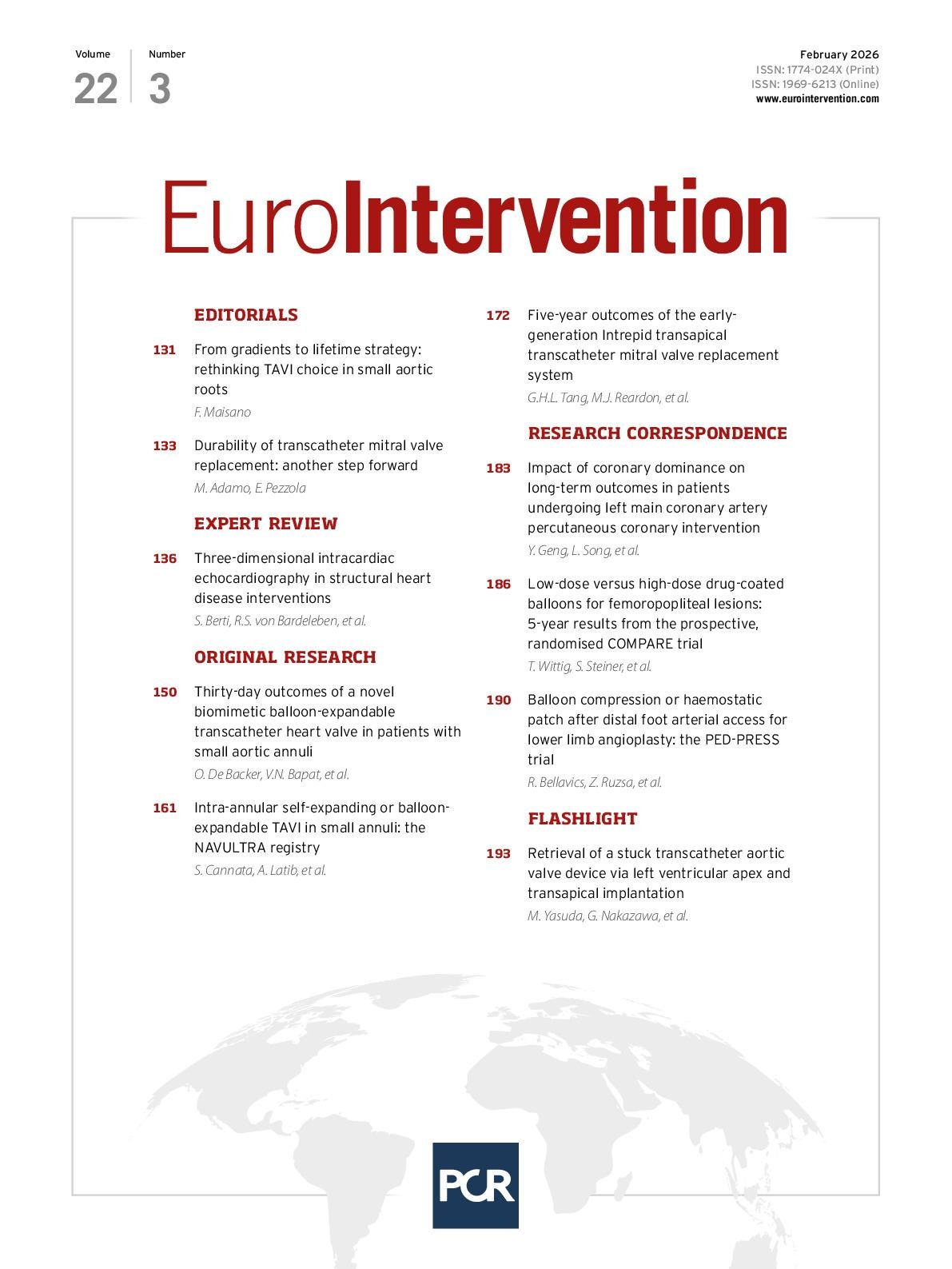
In this issue of EuroIntervention, Tang and colleagues4 report the 5-year outcomes from the Intrepid TMVR global Pilot Study, a multicentre, prospective, single-arm study including 95 patients who received the early-generation Intrepid transapical (TA) system between 2015 and 2019. These results are highly relevant, representing the longest follow-up currently available for any TMVR device.
The study reported a 5-year all-cause mortality rate of 66.7% and a 5-year heart failure hospitalisation rate of 55.4%. These high rates of events can be easily explained by the TA access used and the comorbidity burden of the population included. The high rates of 30-day and 1-year mortality (18.9% and 31.9%, respectively) are in line with the Expanded Clinical Study of the Tendyne Mitral Valve System, which also utilised TA access, where 90-day and 1-year all-cause mortality rates were 16.2% and 31.8%, respectively5. The 5-year event rates are in line with randomised control trials and registries including patients with secondary MR undergoing TEER67. Indeed, the majority of patients had secondary MR (78.7%) and left ventricular dysfunction (70.2%). Results from the Intrepid TMVR Early Feasibility Study using the new transfemoral-transseptal delivery approach reported very low 30-day (0%) and 1-year (6.7%) all-cause mortality8. Similarly, the SAPIEN M3 system, the only transfemoral-transseptal TMVR device with a European Conformity (CE) mark, reported low 30-day and 1-year mortality rates in the ENCIRCLE Trial (0.7% and 13.9%, respectively)9. Interestingly, the populations included in the Intrepid TF and ENCIRCLE trials were slightly different compared with those included in the Intrepid TA and Tendyne studies (lower proportion of secondary MR and better left ventricular ejection fraction in the former two) (Table 1). Thus, moving towards less invasive approaches and optimising patient selection for TMVR are crucial steps to improve clinical outcome. In addition, the adoption of a holistic approach with the aim of reducing the residual risk of these complex patients may be helpful12. Notably, current European guidelines report TMVR as a possible therapeutic option only for patients deemed unsuitable for surgery or TEER, with primary MR or mixed mitral valve disease or mitral stenosis, but not in those with secondary MR1.
Beyond patient selection and overall outcomes, a major result reported by Tang et al is the Intrepid valve performance at 5 years, since evidence on long-term durability for any TMVR technology remains limited to case reports10.
The Intrepid TA TMVR system demonstrated sustained reduction of MR, durable valve function, and a low incidence of haemodynamic valve deterioration. Among 5-year survivors, all patients remained free from residual MR greater than mild (100%), with a mean transmitral gradient of 3.6 mmHg. No significant paravalvular leak (PVL) was observed. Of note, mitral annular calcification (MAC) was an exclusion criterion, and results from the MAC cohort of the APOLLO-EU study (ClinicalTrials.gov: NCT05496998) are awaited to confirm this low rate of PVL in more complex anatomies. The incidence of moderate haemodynamic valve deterioration was 1.4% (1/69), and no cases of severe deterioration were reported at 5 years. No other TMVR studies to date have provided such detailed information on long-term performance.
A stable LVOT peak gradient was maintained at follow-up (6 mmHg), likely facilitated by the lack of left ventricular reverse remodelling. Indeed, no significant changes in left ventricular dimensions or stroke volume were observed.
Device thrombosis with sequelae (heart failure hospitalisation or embolism) occurred in 1.95 per 100 patient-years (5 events in total, 2 within 1 year). These events were associated with echocardiographic evidence of mitral stenosis. Almost all of these patients received suboptimal antithrombotic therapy (clopidogrel or warfarin with no target international normalised ratio values) and were managed successfully by intensifying or initiating anticoagulation. Thus, as well stated by the authors, an appropriate anticoagulation regimen is of paramount importance to ensure a decreased risk of device thrombosis.
Endocarditis occurred in 1.17 per 100 patient-years, in line with data on transcatheter aortic valve interventions.
Unfortunately, it must be acknowledged that the number of 5-year survivors with available echocardiographic data was approximately 20, only slightly more than a case series. Thus, further data are needed to confirm the favourable long-term performance of Intrepid as well as to establish the durability of other platforms. However, as already stated, the results are unique; the events were centrally adjudicated and echocardiographic images centrally analysed; and last but not least, the Intrepid TMVR device, both early and current generation, consists of the same valve design. It is a self-expanding nitinol dual-stent design: the inner stent frame houses a 27 mm trileaflet bovine pericardial valve, while the outer stent anchors the prosthesis to the native mitral anatomy. Therefore, durability outcomes from the early-generation study can reasonably be considered applicable to the current-generation device.
These preliminary data are promising and reassuring, and another step forward has definitely been taken towards increased knowledge in the TMVR field.
Table 1. Baseline characteristics and outcomes at the longest follow-up available after TMVR.
| INTREPID TA global Pilot Study4 | INTREPID TF Early Feasibility Study11 | TENDYNE Expanded Clinical Study512 | SAPIEN M3 ENCIRCLE Trial9 | |
|---|---|---|---|---|
| Baseline characteristics | ||||
| Number of patients | 95 | 33 | 191 | 299 |
| Age, years | 74.0±9.2 | 78.6±7.4 | 74.1±8.0 | 77 (70-82) |
| STS, % | 6.5±4.8 | 5.3±2.8 | 7.7±6.6 | 6.6±4.1 |
| NYHA III/IV | 88.5 (84) | 69.7 (23) | 70.2 (134) | 71 (213) |
| Secondary MR | 78.7 (74) | 39.4 (13) | 88.5 (169) | 58 (173) |
| LVEF, % | 44.0 (36.0-55.0) | 50.0 (45.0-60.9) | 44.7±8.8 | 49.5 (38.7-58.1) |
| Longest available follow-up | 5 years | 2 years | 3 years | 1 year |
| All-cause mortality | 66.7 (62) | 16.8 (5) | 51.3 (93) | 13.9 (40) |
| CV mortality | 51.6 (43) | 10.2 (3) | 45.6 (82) | 8.9 (25) |
| Non-CV mortality | 31.4 (19) | 6.6 (2) | 5.7 (11) | 5.0 (15) |
| HFH | 55.4 (37) | 25.7 (7) | 35.1 (67) | 16.7 (47) |
| NYHA Class I/II | 84.6 (26) | 80 (16) | 80.6 (54) | 88 (205) |
| Valve thrombosis | 12.2 (6) | 7.4 (2) | 5.8 (11) | 6.7 (19) |
| Disabling stroke | 9.1 (6) | 0 (0) | 4.7 (9) | 3.9 (11) |
| Haemolysis | 0 (0) | - | - | 7.1 (21) |
| Endocarditis | 4.6 (3) | 3.4 (1) | 6.3 (12) | 1.5 (4) |
| Major bleeding events | 32.5 (27) | 35.1 (11) | 27.7 (53) | 18.5 (52) |
| No or mild residual MR | 100 (21) | 100 (20) | 100 (60) | 95.7 (222) |
| Mean MV gradient, mmHg | 3.7 (3.0-4.7) | 3.9 (3.1-5.5) | 3.8±1.5 | 5.5 |
| PVL | 0 (0) | 0 (0) | 8.9 (17) | 3.8 (11) |
| LVOT peak gradient, mmHg | 6.0 (3.8-8.8) | 8.4 (7.4-11.1) | - | - |
| Dichotomic variables are expressed as % (n). Continuous variables are expressed as mean±standard deviation or median (IQR). CV: cardiovascular; HFH: heart failure hospitalisation; IQR: interquartile range; LVEF: left ventricular ejection fraction; LVOT: left ventricular outflow tract; MR: mitral regurgitation; MV: mitral valve; NYHA: New York Heart Association; PVL: paravalvular leak; STS: Society of Thoracic Surgeons; TA: transapical; TF: transfemoral; TMVR: transcatheter mitral valve replacement | ||||
Conflict of interest statement
M. Adamo reports speaker fees from Abbott, Edwards Lifesciences, and Medtronic. E. Pezzola has no conflicts of interest to declare.