Cory:
Unlock Your AI Assistant Now!
Annual volumes of mitral transcatheter edge-to-edge repair (M-TEER) procedures as well as the number of centres performing this in Europe are increasing1. Based on data from three randomised clinical trials, the recently published European Society of Cardiology/European Association for Cardio-Thoracic Surgery (ESC/EACTS) Guidelines for the management of valvular heart disease have provided a revised Class I recommendation for M-TEER in patients with severe ventricular functional mitral regurgitation (FMR) without concomitant coronary artery disease (CAD) if symptoms persist despite optimised guideline-directed heart failure therapy2. However, apart from guideline recommendations, the spectrum of patients with ventricular FMR in everyday practice is broad, and there is still often substantial debate in multidisciplinary Heart Teams on when to apply M-TEER, in whom to apply it, and what results to expect.
Right after release of the most recently published RESHAPE-HF2 trial3, Markus Anker and colleagues presented a study-level meta-analysis to synthesise data from RESHAPE-HF2 with those from the previously published COAPT and MITRA-FR trials4. Their analysis suggested substantial between-trial heterogeneity and concluded that the benefit of M-TEER in addition to optimised guideline-directed heart failure therapy compared with optimised guideline-directed heart failure therapy alone were dependent on the type of statistical model applied. A significant benefit for the individual endpoint of unplanned heart failure hospitalisations (HFHs) within 24 months and the combined endpoint of first event of HFH or all-cause mortality within 24 months was observed with M-TEER when the most commonly used method for fitting the random-effects model for meta-analysis (i.e., the DerSimonian-Laird method) was used. In contrast, when a modified, more conservative method for randomâeffects metaâanalysis (i.e., the Hartung-Knapp method) was applied, such benefit was no longer evident4.
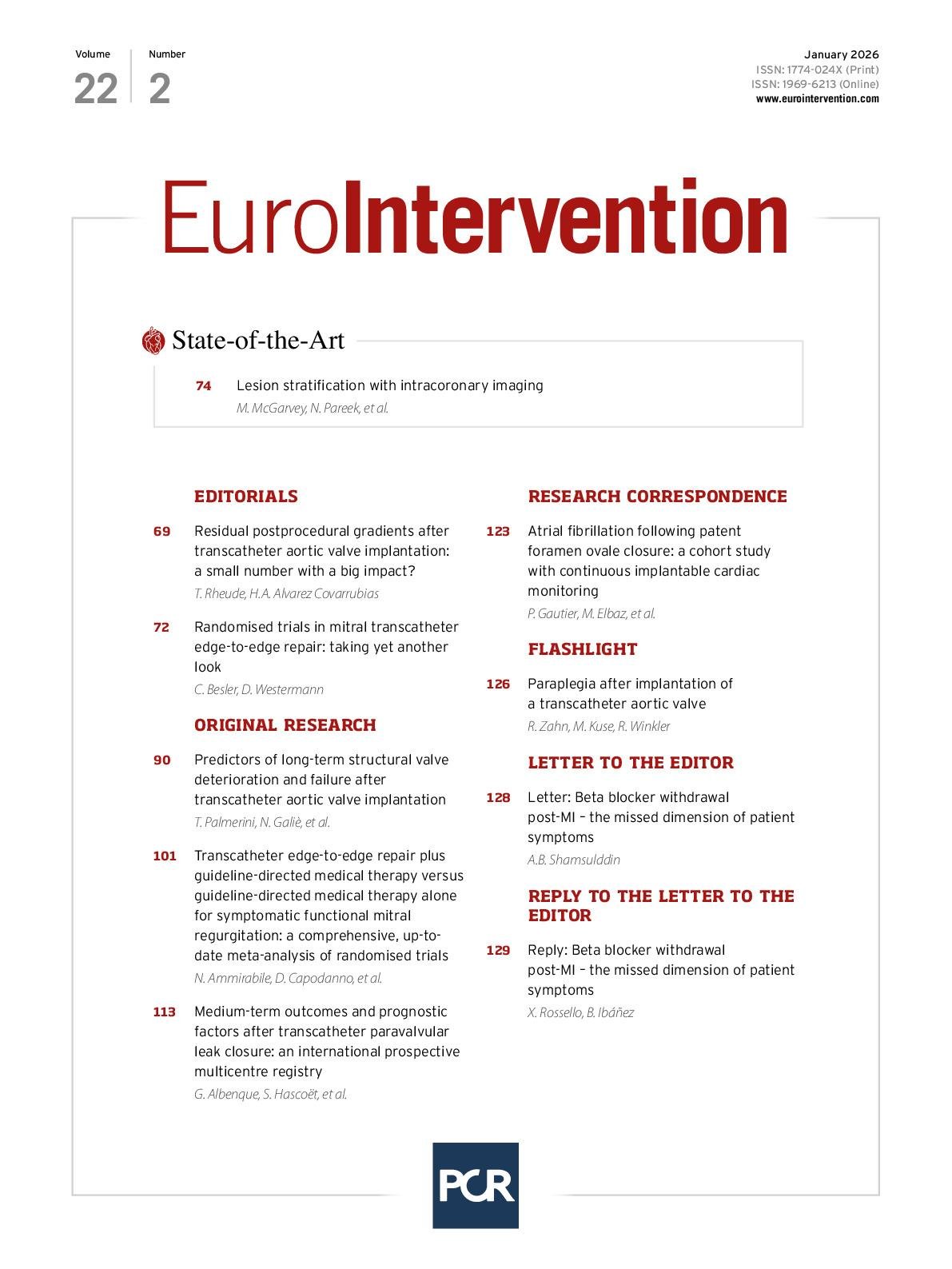
In this issue of EuroIntervention, the study-level meta-analysis of M-TEER trials by Ammirabile and colleagues, despite using a slightly different statistical approach, extends these findings and clearly points out the statistical difficulties when applying the randomâeffects model in meta-analyses5.
A random-effects model requires an estimation of the between-study variance, and the precision of such estimation is obviously lower in meta-analyses with just three trials of moderate size being included6. The Hartung-Knapp method provides a refined estimate of the between-study variance that is less biased and may, therefore, provide more robust results in meta-analyses with a small number of studies. Taking these considerations into account, both the above-mentioned study-level meta-analyses suggest that there is no benefit for M-TEER in terms of HFH or mortality after 24 months when COAPT, MITRA-FR and RESHAPE-HF2 are included. Notably, leave-one-trial-out sensitivity analyses by Ammirabile et al5 suggest that the lack of clinical benefit of M-TEER, as observed when applying a more stringent statistical approach, is due to variance between the included trials. Excluding MITRA-FR, but not COAPT or RESHAPE-HF2, offset trial heterogeneity and led to significant reductions in HFH and even mortality endpoints.
The findings of both meta-analyses45 advance our understanding of the currently available evidence for M-TEER in patients with ventricular FMR but also help in shaping future M-TEER trials in this patient population. Importantly, the results remind us that designing trials in this heterogeneous patient population is complex both in terms of patient selection and statistics, as results may differ markedly depending on patient characteristics, disease stage, composition of clinical endpoints, or length of follow-up. Actually, it is impossible to directly compare COAPT and MITRA-FR, because marked differences in terms of patient selection and other factors influencing patient outcomes (as outlined by Ammirabile et al5) do not allow such a comparison. RESHAPE-HF2 was considered by some as a tie-breaker. Yet, there has never been a real draw between COAPT and MITRA-FR in terms of the clinical efficacy of M-TEER due to the fact that these trials applied M-TEER in two very different patient populations and study settings.
In addition, acknowledging the fact that there are subgroups across the broad spectrum of FMR patients who derive less or no improvement in clinical outcome is crucial in moving the field forward. Dissecting the outcomes of positive and neutral/negative trials, i.e., COAPT and RESHAPE-HF2 as well as MITRA-FR, will form the basis for future trials. The question of the patient-related factors that determine whether a patient ultimately derives clinical benefit after M-TEER is still unanswered. Several factors have been identified, and the new ESC guideline document2 provides a list of clinical and echocardiographic criteria that predict outcome improvement in these patients after M-TEER, including cutoffs for left and right ventricular function, natriuretic peptide levels, systolic pulmonary artery pressures, or heart failure stage. These criteria provide guidance based on the current state of knowledge in the field, but in reality, the story is likely to be much more complex. More granular patient phenotyping − including cardiac and extracardiac comorbidities as well as multimodality imaging of MR and cardiac chamber function/dimension integrated in the design of new prospective studies − is one step towards gaining more insights into the specific patient subgroups that are likely to derive a benefit in terms of hard clinical endpoints after M-TEER.
Overall, the rates of HFH or all-cause death after M-TEER in patients with ventricular FMR remain remarkably high. This aspect is often neglected during discussion of M-TEER trials but is highlighted in the Kaplan-Meier curves of the present paper by Ammirabile et al5. This clearly underlines the need for further improvements in patient outcomes. Efforts to refine M-TEER by addressing specific ventricular FMR phenotypes, earlier mitral regurgitation disease stages, or patients with not yet uptitrated guideline-directed heart failure therapy hold promise in maximising its benefit for patient outcomes and should be explored. In the end, this can only be accomplished by additional randomised clinical trials testing well-defined patient subgroups.
Conflict of interest statement
The authors have no conflicts of interest to declare.